

If you have ever thought about learning French language, chances are someone has already told you like “French is such hard language!“ and maybe you have seen some memes about French pronunciation and the silent letters that make not sense. Same goes to me as well, when I firstly started, the very first word that confused me was “beaucoup” pronounce as bo-coo, but p is silent. So at that moment I really thought people are right “French is impossible”
But I was wrong, here is the truth, when I personally learnt it and got to higher C1 level. And now I’ll share my experience with you, so that you should face these difficulties as I faced.

Why people think French is Hard
When you heard someone say’s French is difficult, they’re usually thinking of a few specific things. And honestly, I got it. And when I was exact at your level these things scared me too, mostly whenever I opened a French grammar book.
But now you don’t need to worry more because today I will tell you where mostly learners get stuck or confused. Lets break it down step by step.
1. Pronunciation and silent Letters
French is said to be a nasal or smooth, to the learners, French is a tongue twister. You see all these letters in a word and yet you are not expected to pronounce half of them. Have the term beaucoup (very/much) – it looks like bo-ko-up, which is in fact bo-coo. The last p is silent and that is typical of French.
This is frustrating to newcomers. You begin to ask yourself: Why write letters when you do not even pronounce it? And that is merely the development of language, and with time your ear adapts.
2. Gendered Nouns (Le/La)
The next difficulty is that all nouns have a gender – either it is a masculine (le) or feminine (la). For example:
- le livre (the book)
- la table (the table)
To an English speaker this is against all forms of logic. What is the reason of a table being feminine? Does it change how you use it? In French, yes. The word gender influences the adjectives and even verbs that surround it.
This may start off as an endless list to memorize. But believe me, with practice, your brain would begin to instinctively sense when a word is masculine or feminine.
3. Verb Conjugations (Especially Irregular Verbs)
This is probably the number one reason learners panic. In English, verbs are pretty chill:
- I eat
- You eat
- He eats
In French, the same verb changes much more:
- Je mange (I eat)
- Tu manges (You eat)
- Il/Elle mange (He/She eats)
- Nous mangeons (We eat)
- Vous mangez (You all eat)
- Ils/Elles mangent (They eat)
And that’s just the regular verbs! When you meet irregular verbs like être (to be) or avoir (to have), it feels like a whole new game.
4. Accents and Special Characters
French has several accent marks: é, è, ê, ç, à. At first, they seem decorative, but they actually change the meaning and pronunciation. For example:
- été = summer
- été (without the accent) doesn’t exist!
- ou = or
- où = where
These little marks can make a big difference. And yes, in exams like TEF or DELF, writing the wrong accent is counted as a mistake.
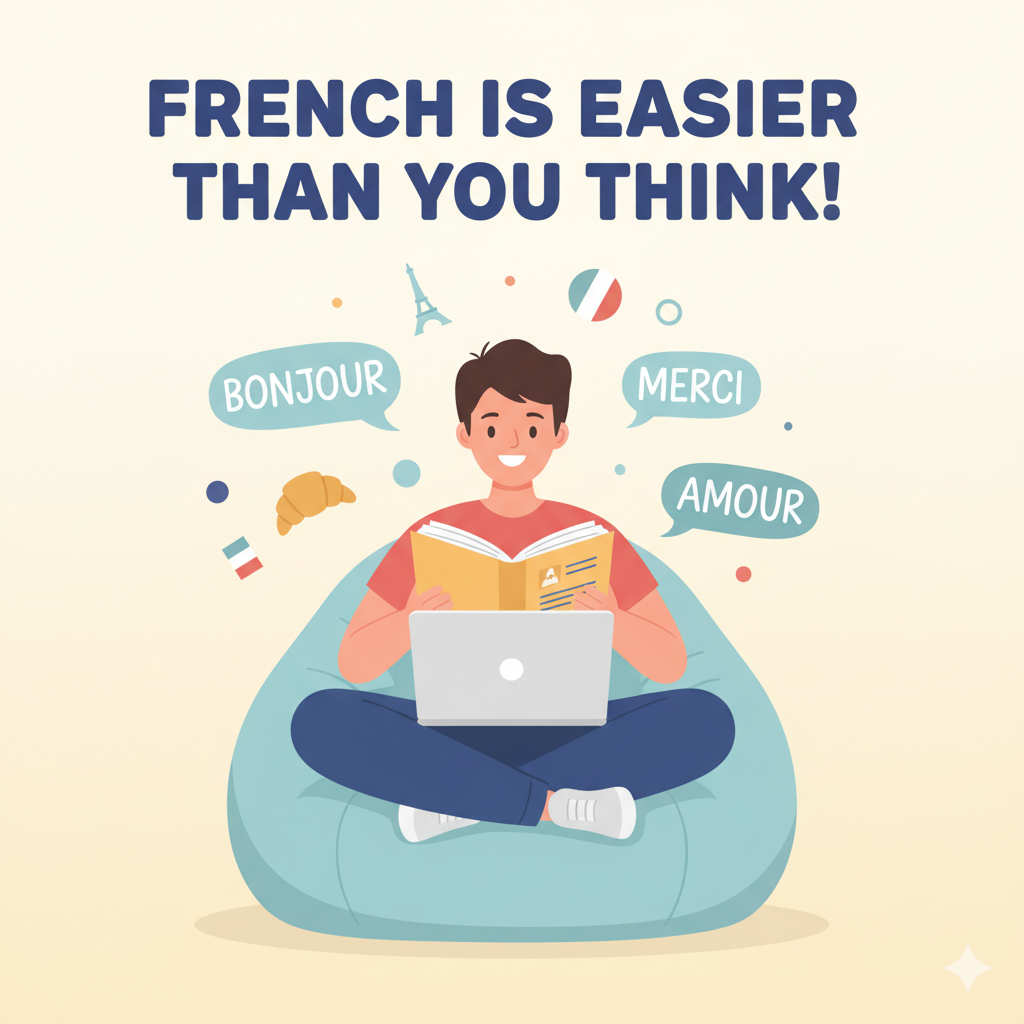
Why French Is Actually Easier Than You Think
When the people mention French, they make it sound hard and exaggerated. But it is the reality that French equally has an abundance of things that make it easier over the other languages. Indeed, there are learners who have found it to be more logical than English in a number of ways. We can do through the principal causes.
1. Shared Vocabulary with English
The fact that French and English are heavily overlapping is one of the largest benefits. Due to history (Norman invasion in 1066, which you have studied at school, if not, I will explain it to you now), thousands of words were borrowed by English. This is why when you begin to study, you will see billions of words you know.
For example:
- important (important)
- restaurant (restaurant)
- communication (communication)
Even though pronunciation is different, the meaning is almost identical. Around 30–40% of English vocabulary has French roots. So if you already speak English, you’re not starting from zero.
2. Logical Grammar Rules
The rules of French grammar are even, there are exceptions, of course, but there are numerous ones. When you learn how a rule functions, it is applicable in dozens of words. As an example, the majority of verbs with endings –er (parler, manger, chanter) are similar to this rule when conjugated.
This is in contrast to the English spelling rules, which are everywhere ( think: though, tough, through, thought). French may seem intimidating initially, yet it is usually more predictable.
3. Pronunciation Is Not as Bad as It Seems
French sounds at the start are disorienting. However, the reality is that there is French pronunciation that is patterned as well. Having learned a sound, you can use it repeatedly.
As an example, the termination -tion is invariably articulated syo (as nation – nass-yon). French is more stable than English whereby the same letters may be pronounced differently in other words.
4. Spelling Matches Sounds More Closely Than English
English is infamous with the words that are spelled in a certain manner and are in fact pronounced entirely differently (knight, enough, island). The same thing goes with the French language where, when you have the rules of pronunciation, you can usually tell how to say a particular word simply by looking at it. Yes, there are silent letters, yet they have rules to be followed.
5. Tons of Learning Resources Available
With its large group of learners, and free or low-cost resources, (i.e. apps, YouTube channels, podcasts, grammar sites, exam-prep manuals, etc.), unlike smaller languages, French has enormous amounts of it. It is never a solitary journey.
In my case, as a person, I discovered that I could watch Netflix as a French teenager with subtitles, and it was a game-changer. I did not study it, I was watching the show, and the language gradually began to become natural.
Meanwhile, French is said to be the hard one, the thing is that it provides you with a lot of working ground: you know words, there are logical rules, and unlimited resources. When you take advantage of them, it is not that French anymore is a mountain you should not be able to climb, rather a mountain with obvious steps.
Practical Tips to Make Learning French Easier

French doesn’t have to be overwhelming. The key is to approach it smartly instead of trying to swallow the whole language at once. Here are some strategies that worked for me (and for many learners I’ve seen succeed).
1. Start with Everyday Phrases
Don’t begin with complicated grammar. Learn useful phrases you can actually use in daily life:
- Bonjour, comment ça va ? (Hello, how are you?)
- Je voudrais un café. (I would like a coffee.)
- Où est la gare ? (Where is the station?)
Once you can use these in real conversations, you’ll feel immediate progress — and that motivates you to keep going.
2. Focus on Pronunciation Early
French pronunciation can be a challenge, but with practice of the ear during the initial stages, the later onset of errors becomes prevented. Attempt the step of imitating native speakers, or device applications that allow you to record your voice and compare.
I did it when I was beginning by rehearsing the word rue (street) as that French consonant R sound is ubiquitous. It was something that could not have been done at the beginning, yet it became simple with practice.
3. Learn High-Frequency Words First
A list of 500-1000 common words is better than just a list of random words that you memorize. These comprise the majority of conversations in everyday. In the form of: avoir, etre, faire, aller, pouvoir, vouloir. These, when you have them, you will see a huge portion of the spoken French.
4. Use French Media Daily
Learn French as part of your life, and not as your study period. You can watch such Netflix series as Lupin, listen to French music (Stromae is a great example), or watch French YouTubers. Your brain is training even though you are not aware that you are learning all the words.
I used to play French podcasts in the course of my chores when I was preparing to pass examinations. It was not reading, but it made my ears sensitive to the rhythm of the language.
5. Practice Speaking as Soon as Possible
Most learners procrastinate speaking due to the fact that they are not ready. The truth? Waiting will never make you feel prepared. Begin small – even saying a Bonjour to yourself in the mirror, or one minute voice recording.
In case you can find a speaking partner using the internet or participating in a language exchange. Early talking is a confidence-developing skill and you will learn quicker than you would by keeping the information in your notebook.
6. Prepare Smartly for Exams (TEF, DELF, etc.)
When you are supposed to pass a French test, you do not simply learn the French language. Revise old test papers, get used to the format and do it under time. I have also witnessed the passing of average French-skilled students on the basis of knowing how to structure the exam than the others.
It is not a concept to be flawless but to remain steady, realistic and driven. All those little things, such as a phrase learned, a song known, a sentence pronounced, are going to make a fluency.
6. Conclusion
Therefore, is it that difficult to learn French? The straight-forward response is: not to the extent people believe. French, as any other language, has its difficulties associated with it: silent letters, gender nouns, the forms of the verb. Those may seem overwhelming at the outset. However, peeling another layer, you will find that there are not a few benefits in French as well: common vocabulary, logical rules and learning resources without an end.
Ultimately, it is not so much the language itself as how you go about it that makes it hard. With French, like a mountain to climb in a day, this, of course, will not feel possible. However, when you break it down a step at a time, with the proper tactics, discipline, and an element of fun in the process, it is actually very realistic.
On a personal level though, I have seen learners (including myself) who were unable to say simple phrases to having actual conversations, all they needed to do was be patient and regular. And if they can do it, so can you.
Therefore, rather than saying to oneself: Is French really hard? perhaps such a question needs to be supplanted by: Am I ready to take a step, bit by bit?
And should you be so, then here you are. I post some tips, tricks and strategies on this blog, so you can learn French in a smarter way to be able to speak fluent French or to pass some exams such as TEF, TCF and DELF. Hang about and we will see to it that French learning is much easier.